A few years ago, my colleagues and I decided to test the Diaconis-Holmes-Montgomery (DHM) hypothesis that a fair coin, when flipped in the air and caught in the hand, tends to land on its starting side slightly more often than 50% (Diaconis, Holmes, & Montgomery, 2007). In fact, DHM suggested that the effect would be about 1%, and they indicated that in order to detect such a small effect, a diagnostic empirical test would have to feature about 250,000 tosses. As a group, we ended up flipping a series of coins for a total of 350,757 times. In the end, the data strongly supported the DHM hypothesis, albeit with two nuances: the size of the effect depends on the person flipping the coin, and the effect appears to wane with practice. A two-page summary is here, and the full paper is here.
Because of its general appeal, we have presented this work many times, and to large audiences. Our explanation of why the effect occurred went like this (Bartoš et al., 2025, p. 2119):
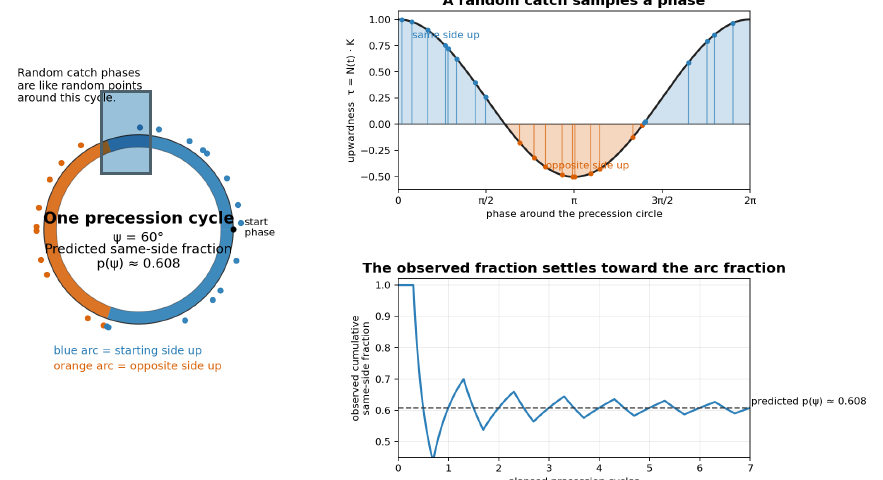
The standard model of coin flipping was extended by Diaconis, Holmes, and Montgomery (DHM; 2007) who proposed that when people flip a ordinary coin, they introduce a small degree of “precession” or wobble—a change in the direction of the axis of rotation throughout the coin’s trajectory. According to the DHM model, precession causes the coin to spend more time in the air with the initial side facing up. Consequently, the coin has a higher chance of landing on the same side as it started (i.e., “same-side bias”). Under the DHM model, this same-side bias is absent only when there is no wobble whatsoever, as any nonzero angle of rotation results in a same-side bias (with a higher degree of wobble resulting in a more pronounced bias).
All audiences accepted this explanation (“it’s the wobble”) without questioning it further (the single exception being a young boy who wanted to know how it worked exactly). But I didn’t truly understand the physics, and it actually seemed counterintuitive to me that the wobble would cause the coin to spend more time in the air with the starting side up. After the first rotation, why would it matter what the wobble was? After all, the coin cannot remember what side it started at. My student František claimed to understand how it worked, but his “explanation” (i.e., waving his hands around in an awkward manner) didn’t do it for me. The solution, I thought, was to find a collaborator in physics, or hire a good software engineer, who could then program a simulation of the coin flying through the air as it spins around its axis.
Time went by, and I never had the time or the money to pursue the idea of a “wobbly coin flip simulator”. A few months ago, however, it struck me that an LLM might be good at this. And indeed, after providing it with the background information and the instructions, ChatGPT Pro was able to construct a beautiful simulator with the accompanying documentation. I recommend you try it out!
The simulator is here (as an html file), and the documentation is here.
Of course it is important to note that this is an idealized simulation, leaving out factors such as air resistance. I tried to keep the model as simple as possible in order to bring out the driving mechanisms as clearly as possible.
References
Bartoš, F., Sarafoglou, A., Godmann, H. R., Sahrani, A., Klein Leunk, D., Gui, P. Y., Voss, D., Ullah, K., Zoubek, M. J., Nippold, F., Aust, F., Vieira, F. F., Islam, C.-G., Zoubek, A. J., Shabani, S., Petter, J., Roos, I. B., Finnemann, A., Lob, A. B., Hoffstadt, M. F., Nak, J., de Ron, J., Derks, K., Huth, K., Terpstra, S., Bastelica, T., Matetovici, M., Ott, V. L., Zetea, A. S., Karnbach, K., Donzallaz, M. C., John, A., Moore, R. M., Assion, F., van Bork, R., Leidinger, T. E., Zhao, X., Karami Motaghi, A., Pan, T., Armstrong, H., Peng, T., Bialas, M., Pang, J. Y.-C., Fu, B., Yang, S., Lin, X., Sleiffer, D., Bognar, M., Aczel, B., & Wagenmakers, E.-J. (2025). Fair coins tend to land on the same side they started: Evidence from 350,757 flips. Journal of the American Statistical Association, 120, 2118-2127. A flyer that summarizes the results is available here. A video of the Ig Nobel award ceremony is here.
TDiaconis, P., Holmes, S., and Montgomery, R. (2007), “Dynamical Bias in the Coin Toss,” SIAM Review, 49, 211–235. DOI: 10.1137/S0036144504446436.
Eric-Jan Wagenmakers
Eric-Jan (EJ) Wagenmakers is professor at the Psychological Methods Group at the University of Amsterdam.