Before proceeding, I should say something about Richard Feynman. In his physics work, Feyman was clearly a genius. And as a public persona, Feynman was certainly also charismatic (see for instance his interviews on YouTube). Moreover, Feynman helped popularize science by writing a series of books meant for a general readership. However, the available evidence suggests that Feynman had some deep flaws in his personality. For instance, the Wikipedia entry states:
At 31 years old, he was reported to frequently pursue married female friends and undergraduate students, and to hire sex workers; according to Gleick, this behavior strained many of his friendships. [Geick, 1992, p. 287]
It is also well documented that Feyman repeatedly assaulted his wife (later his ex-wife) for distracting him from his work. From FBI correspondence (also referenced in the Wikipedia entry):
…the appointee’s wife was granted a divorce from him because of appointee’s constantly working calculus problems in his head as soon as awake, while driving car, sitting in living room, and so forth, and that his one hobby was playing his African drums. His ex-wife reportedly testified that on several occasions when she unwittingly disturbed either his calculus or his drums he flew into a violent rage, during which time he choked her, threw pieces of bric-a-brac about and smashed the furniture…
The Mystery of Feynman’s “Napkin”
With this out of the way, I wish to call attention to the following article:
Christian, B., Russek, E. M., & Griffiths, T. L. (2026). Resolving Feynman’s restaurant problem reveals optimal solutions and human strategies. Proceedings of the National Academy of Sciences of the United States of America, 123, e2509612123. N.B. An interview that provides some background to the project can be found here.
The abstract:
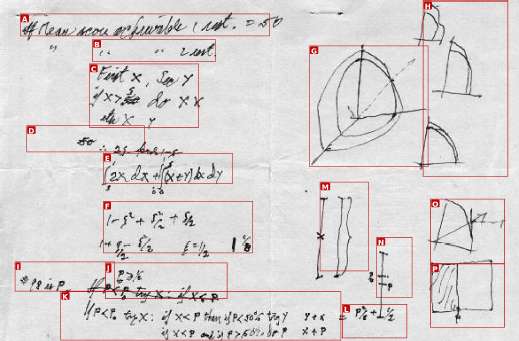
In the 1970s, physicist Richard Feynman turned lunch with a friend into a math problem—how to optimize dish selection over multiple meals—but his handwritten
notes remained a mystery for decades. Here we present the fully deciphered problem and solution, prove its optimality, generalize it to related problems, and compare
the results to human behavior. The optimal policy specifies decreasing thresholds for switching from exploring new dishes to exploiting the best, with thresholds varying
based on the distribution of the quality of dishes. We connect these results to the existing psychological literature on optimal stopping problems, which has explored
close variants on Feynman’s problem, and use our generalization of the solution to explore how the underlying distribution of the quality of the options influences people’s
choices. A preregistered experiment with 2,520 participants shows that people adopt thresholds that decrease linearly with the proportion of trials remaining, consistent with
the observation of linear thresholds in other optimal stopping problems. However, we show that people tend to explore more than predicted by linear thresholds, and that
different distributions of quality result in thresholds with the same slope but different intercepts. These results indicate that people adapt linear thresholds used in optimal
stopping tasks in a way that is sensitive to the underlying distribution—a simple strategy that we show is nearly as effective as Feynman’s solution.
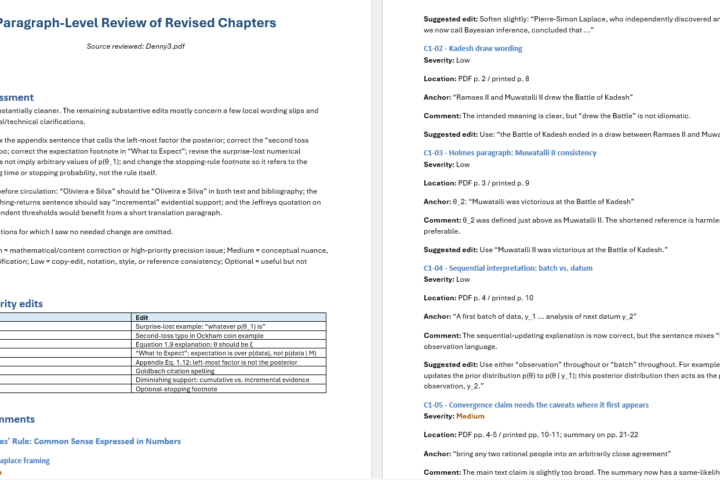
I became interested in this problem, and wondered whether an LLM would be able to decrypt/annotate Feynman’s scribbles. Later I discovered that an annotation had already been provided by Michael Gottlieb, as is actually clear from the acknowledgment section in the PNAS paper. Regardless, I fed ChatGPT the PNAS paper and its supplement, and then in a later stage also the Gottlieb work and a closely related paper by Sang et al. (2020). I then asked ChatGPT for a detailed breakdown of Feyman’s notes.
The ChatGPT Breakdown
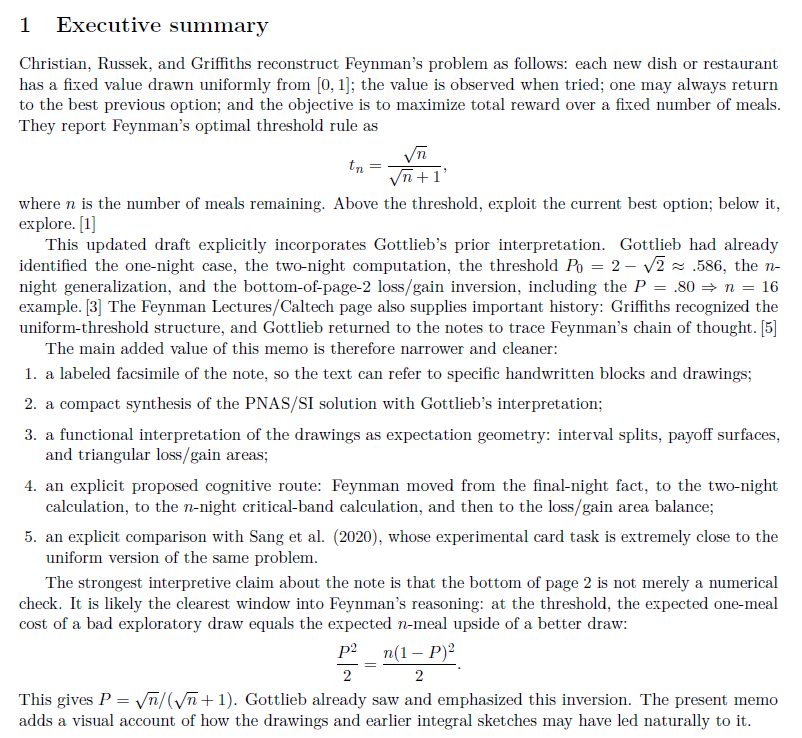
The report by ChatGPT can be found here. I personally found the results highly impressive. The complete Feynman note is systematically dissected and interpreted. Yes, Gottlieb had done something similar before, but I doubt that ChatGPT knew about this in the first round (when I had not given it this information yet). I consider the Chat document another concrete example of how AI can assist scientific work. Here is the executive summary provided by ChatGPT:
References
Christian, B., Russek, E. M., & Griffiths, T. L. (2026). Resolving Feynman’s restaurant problem reveals optimal solutions and human strategies. Proceedings of the National Academy of Sciences of the United States of America, 123, e2509612123.
Gleick, J. (1992). Genius: The Life and Science of Richard Feynman. Pantheon Books.
Sang, K., Todd, P. M., Goldstone, R. L., & Hills, T. T. (2020). Simple threshold rules solve explore/exploit trade-offs in a resource accumulation search task. Cognitive Science, 44, e12817.
Eric-Jan Wagenmakers
Eric-Jan (EJ) Wagenmakers is professor at the Psychological Methods Group at the University of Amsterdam.