A Presentation on Transparency in Science and Statistics

This month I gave a 45-minute presentation “Transparency in Science and Statistics” for the Italian Reproducibility Network. This presentation reflects my recent thinking on the topic. Important themes include “how to use a Ulysses contract to avoid fooling yourself (and others)”, “how to reveal uncertainty that often remains hidden”, “what is model-myopia (and how to avoid it)”, and “can Mertonian…

read more
Redefine Statistical Significance XX: A Chat on P-values with ChatGPT

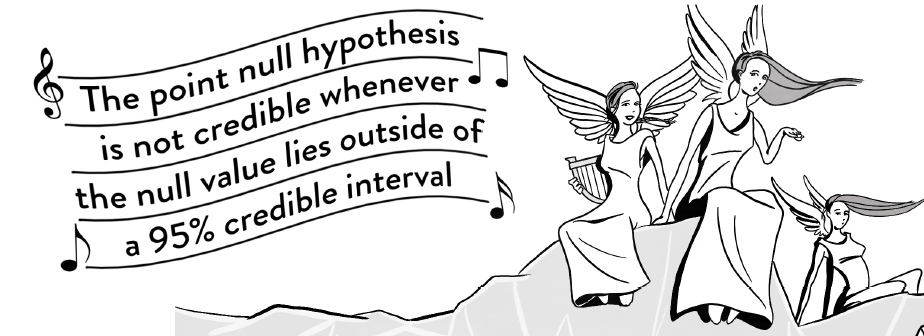
TLDR: ChatGPT rocks It has been more than two years since doing a post for the “Redefine Statistical Significance” series (https://www.bayesianspectacles.org/redefine-statistical-significance-xix-monkey-business/). In this series, Quentin Gronau and I demonstrated through countless examples that p-values just below .05 (“reject the null”!) should be interpreted with great caution, as such p-values provide –at best– only weak evidence against the null (see Benjamin…

read more

An Inconvenient Truth

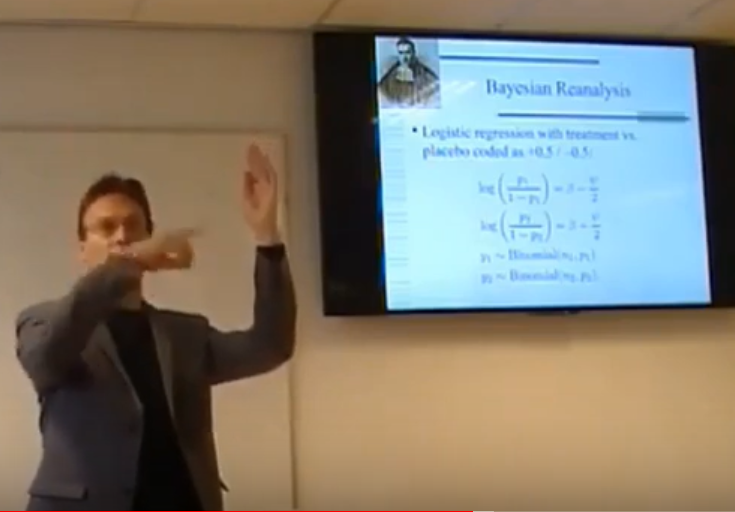
On June 6th I gave a one-hour lecture for SIOS, the Student Initiative for Open Science in Amsterdam (you can follow them on Twitter @StudentIOS). The slides are at https://osf.io/5s9uq/, and a YouTube video of the entire lecture is at https://t.co/u7bkqaC6Ko.                                                                                            Abstract This presentation consists of three parts. In the first, I will present a whirlwind tour…

read more

The Principle of Predictive Irrelevance, or Why Intervals Should Not be Used for Model Comparison Featuring a Point Null Hypothesis

This post summarizes Wagenmakers, E.-J., Lee, M. D., Rouder, J. N., & Morey, R. D. (2019). The principle of predictive irrelevance, or why intervals should not be used for model comparison featuring a point null hypothesis. Manuscript submitted for publication. Preprint available on PsyArXiv: https://psyarxiv.com/rqnu5 Abstract The principle of predictive irrelevance states that when two competing models predict a data…

read more

A Fix for the Kubbel Study

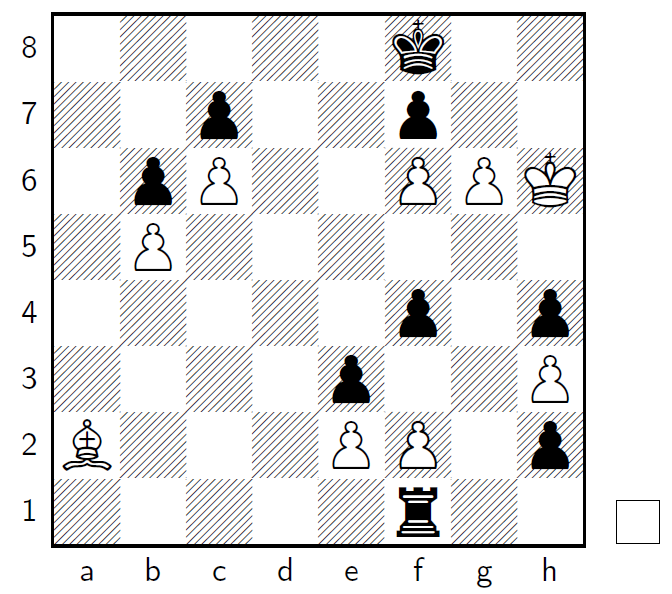
WARNING: this post deals exclusively with a chess endgame study. A previous post discussed the Bristol theme from chess endgame study composition. One of the featured studies was created by the great Leonid Kubbel. This is what I wrote: “Since its inception, the Bristol theme has appealed to several composers. One of the most famous, Leonid Kubbel, created the following…

read more

The Future of the Earth

  Most statisticians know Sir Harold Jeffreys as the conceptual father and tireless promotor of the Bayesian hypothesis test. However, Jeffreys was also a prominent geophysicist. For instance, Jeffreys is credited with the discovery that the earth has a liquid core. Recently, I read Jeffreys’s 1929 book “The Future of the Earth”, which is a smaller and more accessible version…

read more

The Jeffreys-Fisher Maxim and the Bristol Theme in Chess

WARNING: This post starts with two chess studies. They are both magnificent, but if you don’t play chess you might want to skip them. I thank Ulrike Fischer for creating the awesome LaTeX package “chessboard”. NB. The idea discussed here also occurs in Haaf et al. (2019), the topic of a previous post. The Bristol Theme The game of chess…

read more

The Best Statistics Book of All Time, According to a Twitter Poll

Some time ago I ran a twitter poll to determine what people believe is the best statistics book of all time. This is the result: The first thing to note about this poll is that there are only 26 votes. My disappointment at this low number intensified after I ran a control poll, which received more than double the votes:

read more