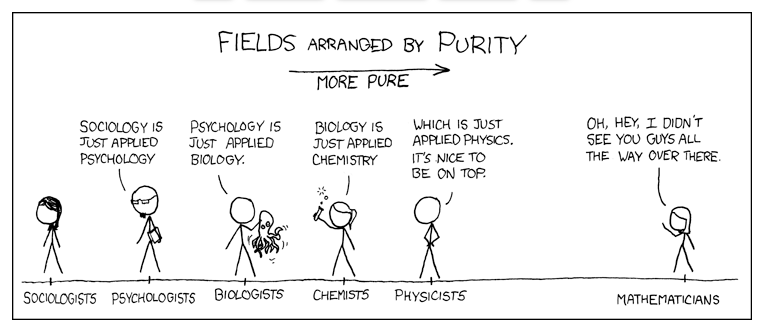
The LLM revolution fundamentally changes how many researchers do their work. The disruption extends even to mathematics, the purest science of them all (xkcd, “purity”, #435):
Armed with an LLM, even researchers without much mathematical training can quickly solve complex mathematical problems. Now that sophisticated mathematical assistance has become so readily available, does it still make sense for students to pursue a career in the field? A beautifully written blog post (“The Enduring Value of Math, in an Age of AI“) argued that a mathematics education remains relevant not so much because of the skills it develops, but mostly because of the character and mindset that it builds: persistence, looking at a problem from different angles, systematic thinking, accepting that some problems are difficult, etc. This is certainly a defense of mathematics education, but it does not, by itself, explain why mathematics should be favored over alternative routes that might cultivate similar character virtues. For concreteness I offer the following three alternatives:
- Composing chess endgame studies.
- Translating Homer from Ancient Greek.
- Pursuing a career in snooker.
Of these three, I am particularly convinced of the character-building value of composing chess endgame studies. Anyway, we leave this aside for now and refocus on the impact that LLMs have on all academic disciplines. Who is responsible for this? How did LLMs come to be? Well, I maintain that my own discipline, psychology, deserves a substantial share of the credit–or blame. The study of learning (and models/mechanisms for learning) dates back at least to Thorndike‘s puzzle boxes and his “law of effect”. Subsequently, animal learning became a central concern of behaviorist psychology, and this in turn became a major source of inspiration for modern reinforcement learning, alongside developments in optimal control and computer science. Another important strand was connectionism. David Rumelhart, Jay McClelland and their collaborators steadfastly developed and promoted parallel distributed processing as an influential connectionist approach to cognition and learning. Rumelhart, Geoff Hinton, and Ronald Williams also helped establish backpropagation as a powerful method for training neural networks. These were key contributions to the intellectual and technical foundations of modern AI. Furthermore, this research was pursued over decades, often in the face of considerable scepticism. In sum, psychological theories and models of learning have helped lay foundations on which modern AI was built, alongside major contributions from other disciplines.
Psychology can therefore claim a considerable responsibility for the LLM revolution. So when someone asks, “What has psychology ever produced that is of any use to anybody?”, a good retort would be: “Well, it helped develop the learning models behind the AI that’s now eyeing your entire discipline for dinner.”
Eric-Jan Wagenmakers
Eric-Jan (EJ) Wagenmakers is professor at the Psychological Methods Group at the University of Amsterdam.
Featured image created by ChatGPT Pro based on the prompt “Please create a Buffon-style picture of the ugly duckling (baby swan) from the fairytale”.